The base
Canal country
Farming and trade by boat
See the toursFind a stop on the map
See 26 route stops
Start by picking a route; tap a pin or stop for its note and Google Maps.
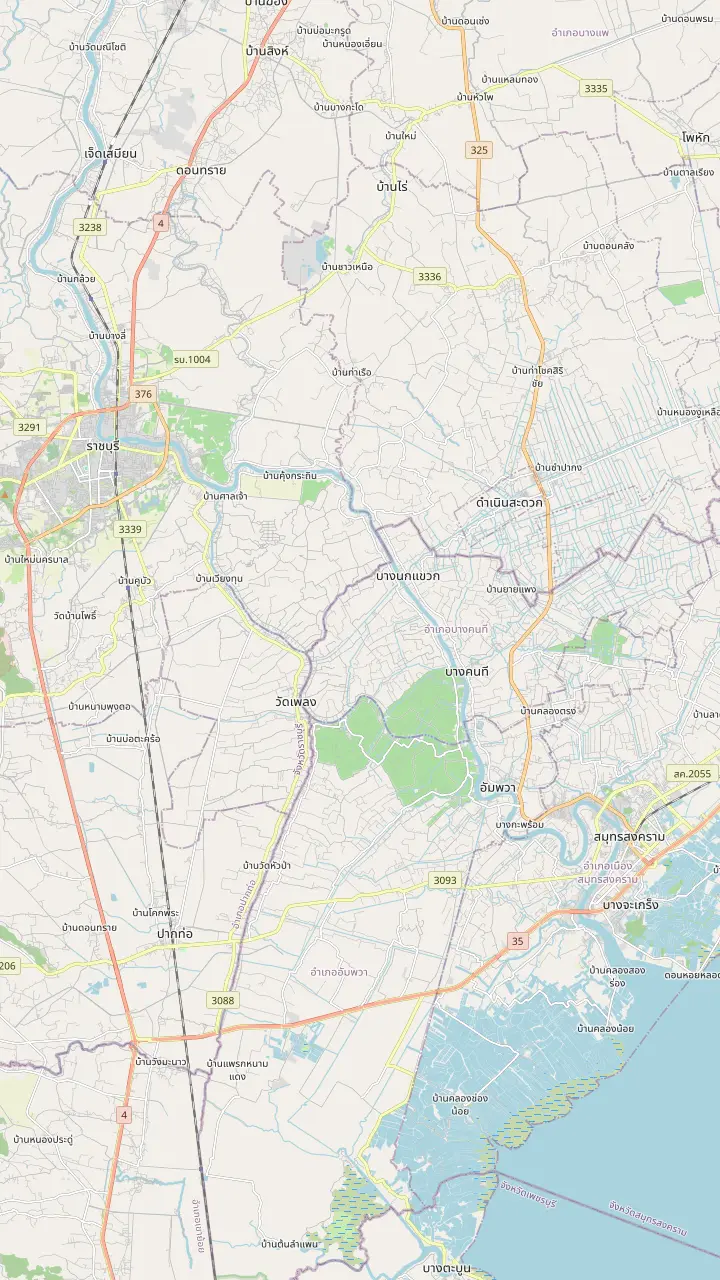
The floating market runs along the canals of Damnoen Saduak in Ratchaburi, about 80 km west of Bangkok.
Google MapsLao Tak Lak, drawn beside the main market on the map, is called Thailand's first traditional floating market.
Google MapsA temple on the canal north-west of the main market, shown here to place the market in the town.
Google MapsA public bus and minivan stop of the district town of Damnoen Saduak.
Google MapsAn elephant show park south-east of the market. This guide does not recommend riding; see the nearby page for the welfare notes.
Google MapsAmphawa is open Friday, Saturday and Sunday.
Google MapsThe railway market in Samut Songkhram, the second market of the combined day tours.
Google MapsThe museum building was formerly the town hall, built in 1922.
Google Maps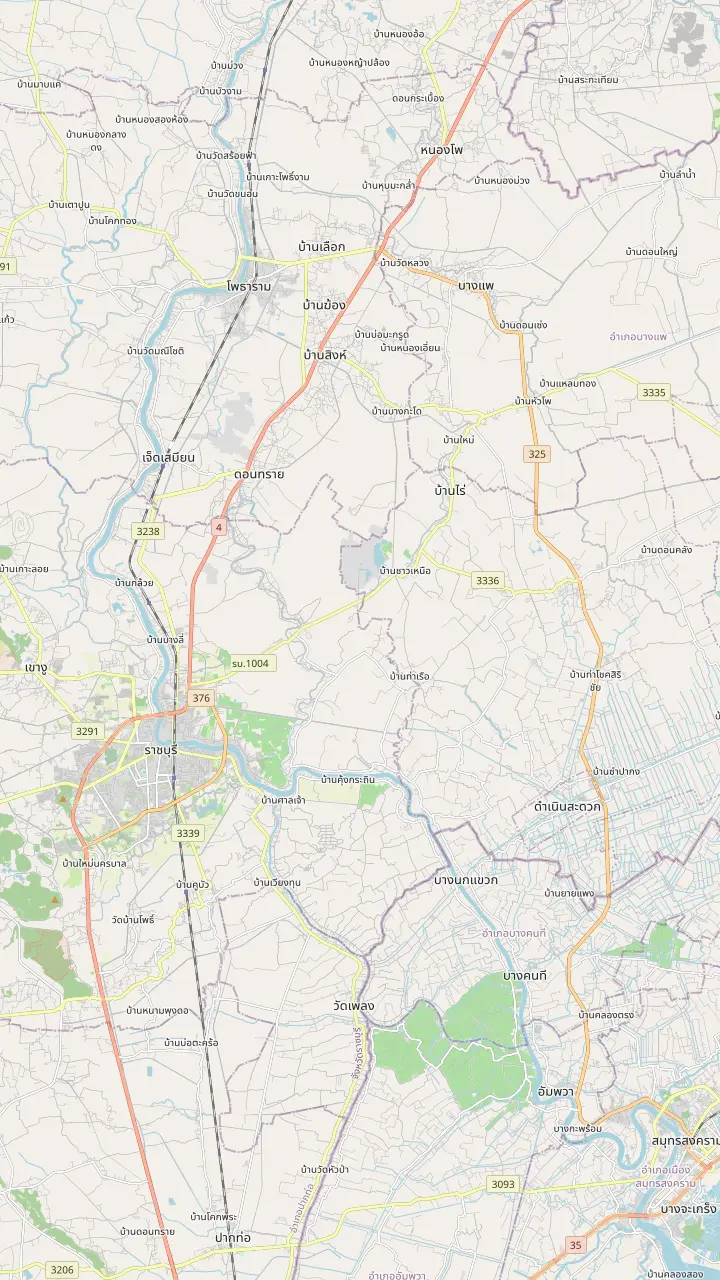
The floating market runs along the canals of Damnoen Saduak in Ratchaburi, about 80 km west of Bangkok.
Google MapsLao Tak Lak, drawn beside the main market on the map, is called Thailand's first traditional floating market.
Google MapsA temple on the canal north-west of the main market, shown here to place the market in the town.
Google MapsThe museum building was formerly the town hall, built in 1922.
Google MapsA traditional Thai-style house holding Nang Yai shadow puppets.
Google MapsAmphawa is open Friday, Saturday and Sunday.
Google Maps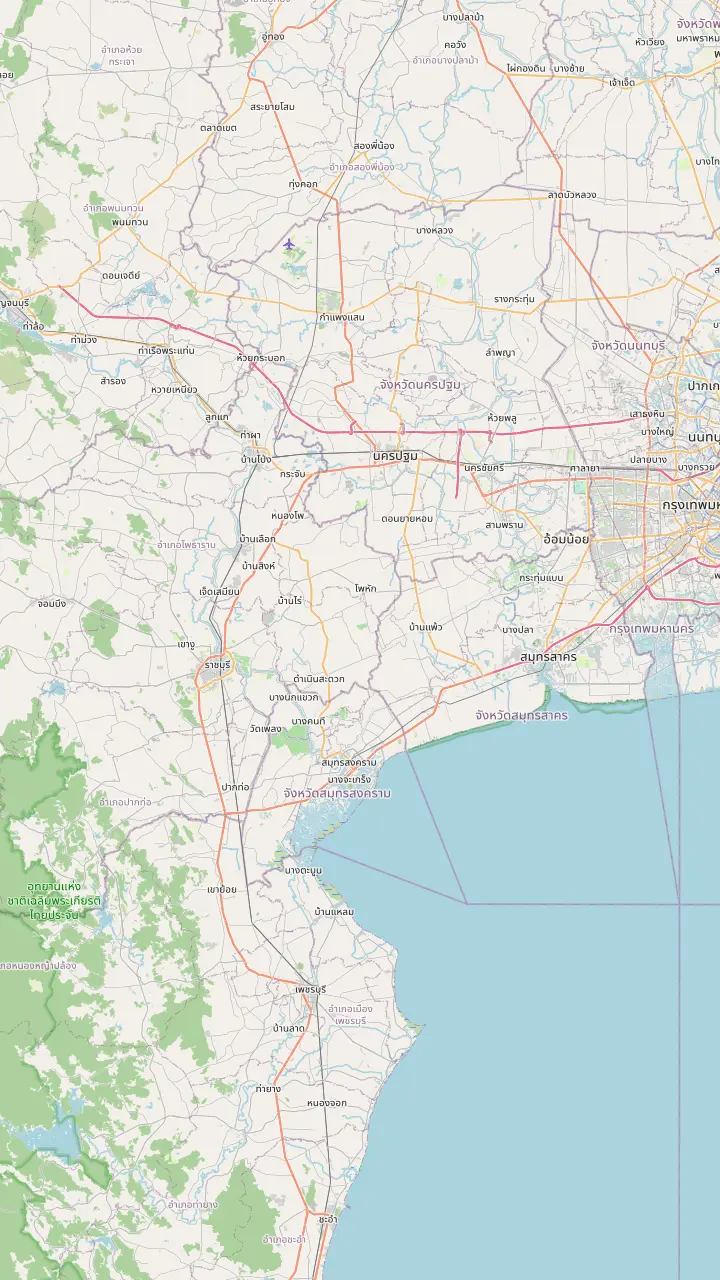
The railway market in Samut Songkhram, the second market of the combined day tours.
Google MapsAmphawa is open Friday, Saturday and Sunday.
Google MapsLao Tak Lak, drawn beside the main market on the map, is called Thailand's first traditional floating market.
Google MapsAn elephant show park south-east of the market. This guide does not recommend riding; see the nearby page for the welfare notes.
Google MapsThe museum building was formerly the town hall, built in 1922.
Google MapsA traditional Thai-style house holding Nang Yai shadow puppets.
Google MapsThe Wat Sam Phran Dragon Temple is in Nakhon Pathom province, east of the market.
Google Maps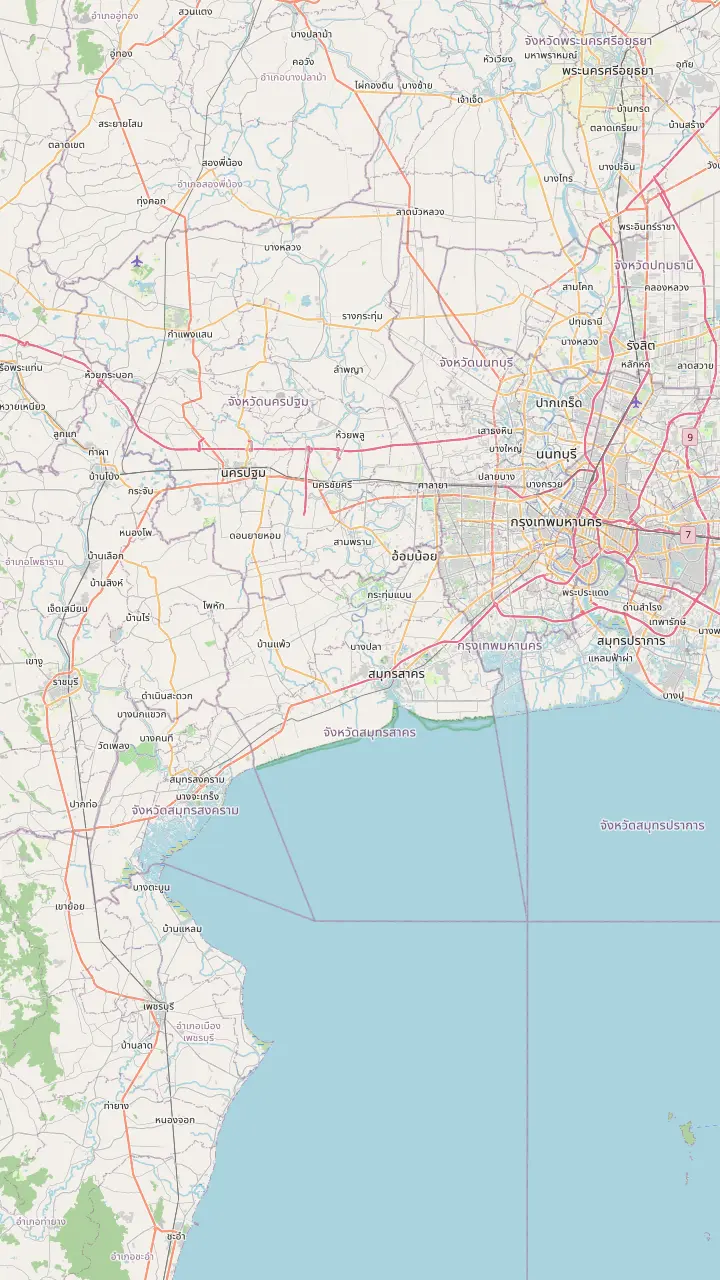
The Grand Palace area in the old town, used here only as a Bangkok reference point.
Google MapsBangkok's Southern Bus Terminal, where buses and minivans to the west leave from.
Google MapsA public bus and minivan stop of the district town of Damnoen Saduak.
Google MapsThe floating market runs along the canals of Damnoen Saduak in Ratchaburi, about 80 km west of Bangkok.
Google MapsThe railway market in Samut Songkhram, the second market of the combined day tours.
Google MapsMap data: © OpenStreetMap contributors
A source-checked account of how a canal landscape in Ratchaburi became a famous market: the kings, the temples, the neighbouring old market and an honest answer on James Bond.
Editorial team, damnoensaduaktour.com · Updated November 12, 2026 · Takes 7 min
The essentials
The history of the Damnoen Saduak floating market starts with the canals, not the stalls. The Tourism Authority of Thailand traces the main canal and its over 200 small side canals to the reign of King Rama IV the Great,1 a grid of waterways cut through low farmland west of Bangkok. In low, wet farmland, canals work as roads, and a floating market is a natural result: sellers come to the buyers by boat, and the buyers wait on the bank.
Ratchaburi itself is far older than the canals. TAT traces the area to the Dvaravati period, a time when Ratchaburi was a key trading hub for the Mon Kingdom.6 Exchange has been part of the place for a very long time, and the canal market belongs to that tradition. The reign of Rama IV, in TAT's account, is when the canal network that supports the district was created, which gives the market its watery setting.
A caution belongs here. The official pages we could read give the canals' reign and the age of some temples, but they do not give a founding date for the market itself. A question such as how old is the Damnoen Saduak floating market has no single official number to offer. What the sources do show is a layered history: an ancient trading province, royal canals, old temples along the water and a visitor market that grew on top of all of it.
Layers of the past
| Layer | What the sources say | Where it shows |
|---|---|---|
| Trading province | Dvaravati centre of the Mon Kingdom6 | Ratchaburi town |
| Royal canals | Over 200 small canals under Rama IV1 | The canal grid |
| Old temple | Described as over 145 years old2 | Wat Choti Thayakaram |
| Old market | First traditional floating market3 | Lao Tak Lak |
| Town museum | Former town hall built in 192215 | Ratchaburi town |
| Film location | 25 productions in 202310 | The floating market |
Dates and descriptions as TAT and the Thailand Film Office state them; the market's own founding date is not given.1
The waterways carry more than markets. TAT's account of a canal tour in Ratchaburi highlights Wat Choti Thayakaram, an historic temple described as over 145 years old,2 and says King Rama V the Great and King Bhumibol Adulyadej the Great both visited it.7 The tour then continued in a solar-powered long-tail boat to a village called Ban Mahat Lek Chek Huat, another place King Rama V visited.8 The tour was designed to follow royal footsteps along the canals.
The same tour shows the other life of the canals: farming and craft. It stopped at the Bang Le Sugar Park and Ladies Golf Pier,11 and at Mae Thongyib Farm, where the activities include weaving, making Thai desserts and garden cruising.12 Travel between the attractions was by long-tail boat.13 These stops are modern tourism products, but each rests on an older way of living beside the water, and that is the background to every photograph of a boat of fruit.
For a reader tracing history on the ground, the lesson is to look past the market stalls. A temple pier, an orchard garden or a sugar-making house tells you as much about the district as the busiest stretch of canal. A listing includes a sugar-making stop of 20 minutes on its way to the market, while another names Wat Chottayakaram between its railway market and its floating market.
Next to the main market sits Lao Tak Lak, which TAT names as Thailand's first traditional floating market, with old Thai-Chinese rows of wooden buildings still standing, a floating market museum and an exhibition about electric boats.3 For anyone interested in the history of the Damnoen Saduak floating market, this is a useful neighbour: it shows what a market of the older kind looks like in wood and water.
The detail about electric boats is worth a thought. The exhibition at Lao Tak Lak is about electric boats, and the canal tour that TAT organised used a solar-powered long-tail boat.8 The canals are no longer only a transport network, they are a heritage product, and the people who manage them are experimenting with quieter, cleaner boats. It is a small part of the market's recent story.
In a listing's route, the Lao Tuk Luck floating market is a photo stop between the main market and the railway market. That is one quick way to see the older market on a day tour, though this site's own day does not stop there. If you travel independently, treat it as a short extension of the visit rather than a separate day, and read the museum and the wooden architecture as the historical payoff of the trip. Ask your guide or the staff on the spot which parts are original and which have been restored, since the sources we could read do not say.
Which story first?
Pick the thread you care about and follow it on the ground.
If I want the oldest market
Lao Tak Lak
Wooden rows of buildings and a museum sit beside it.3
If I want temples and royal history
Wat Choti Thayakaram
King Rama V and King Bhumibol visited the temple.7
If I want the farming past
A palm sugar stop
Locals demonstrate sap collection, boiling and dehydration.18
If I want the film story
Phang Nga, not the canals
TAT ties the 1974 film to Khao Phing Kan.5
If I want local life as it is now
The market at dawn
TAT says it feels like a working market for locals.4
Ages of the market
The base
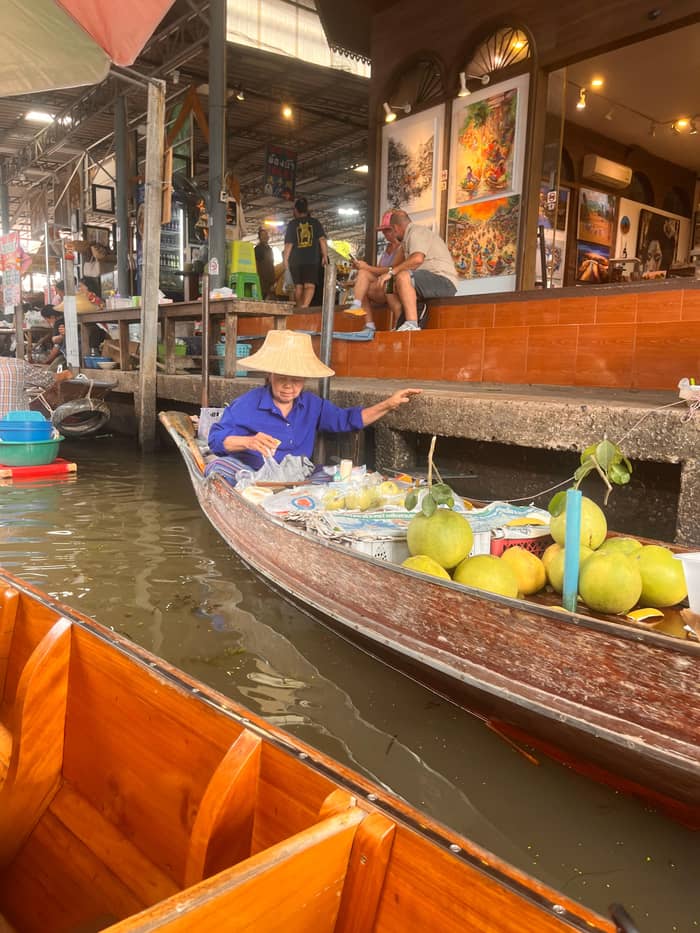
Farming and trade by boat
See the tours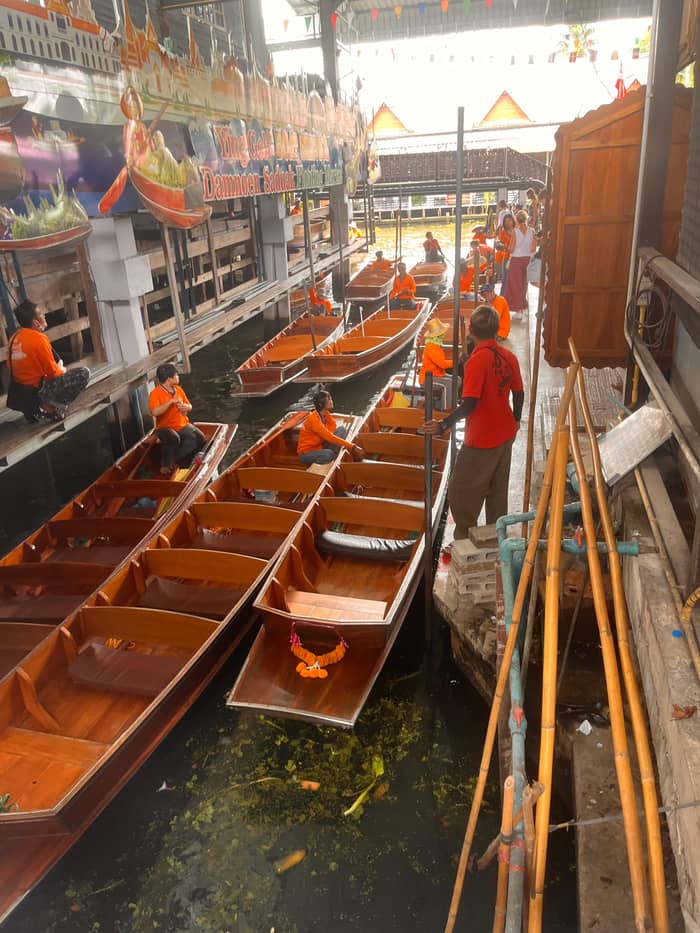
The heritage
Royal visitors on the water
See the tours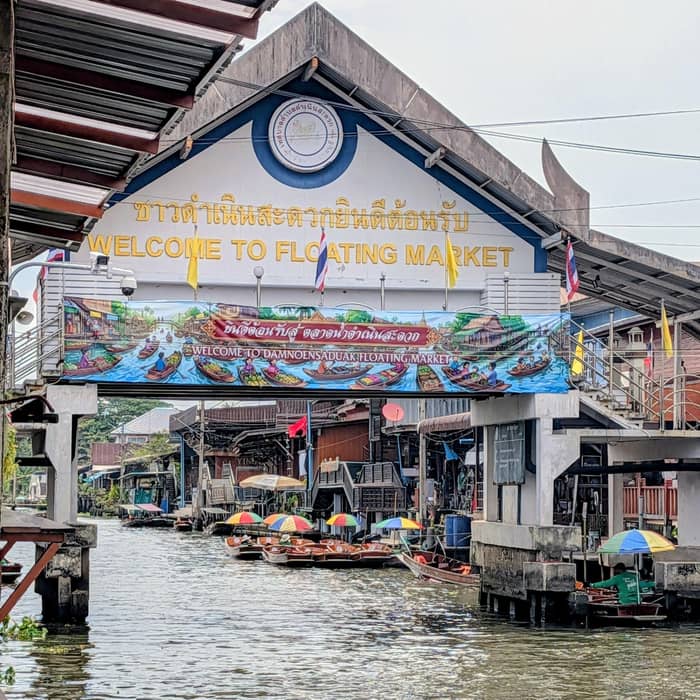
The present
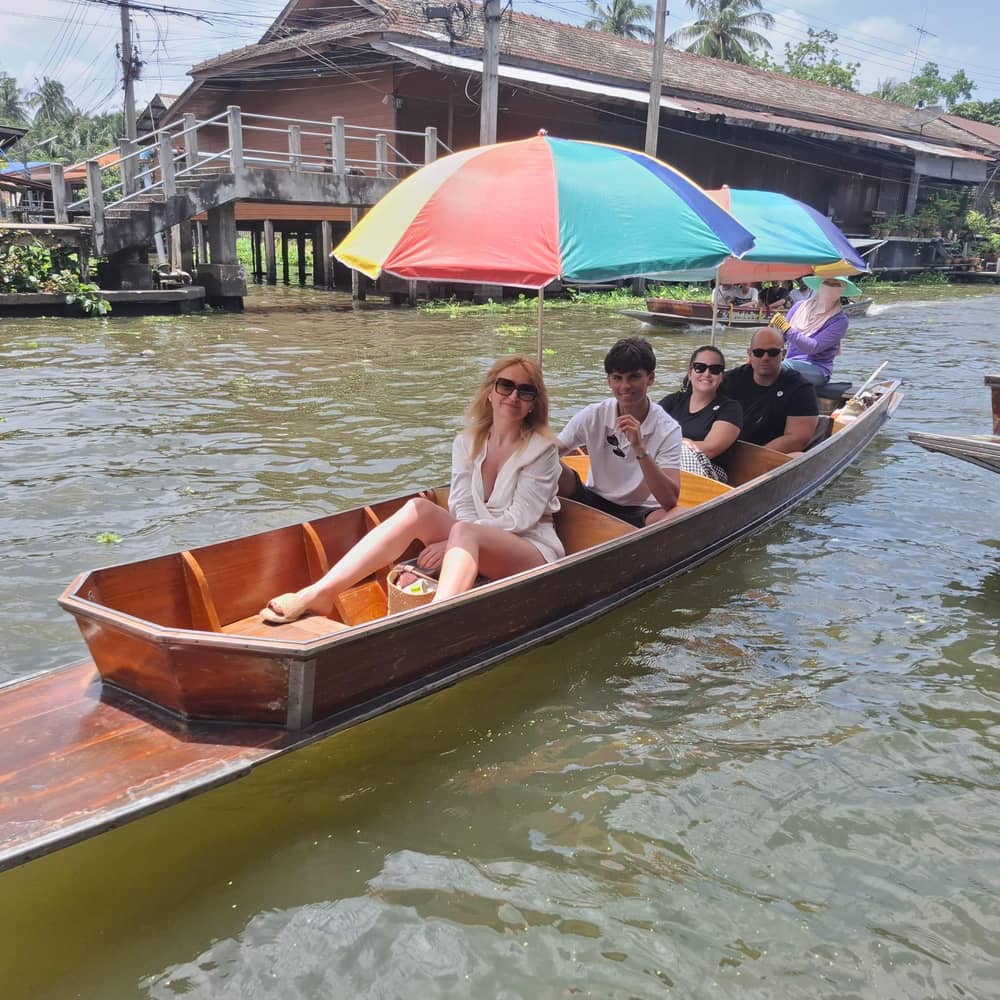
Boats, snacks and cameras
See the toursAt some point the market on these canals became a destination as well as a place to buy fruit. TAT calls the Damnoen Saduak Floating Market world-famous, a canal market of wooden vendor boats loaded with produce and goods,25 and it once included a trip there in a programme for delegates of an international travel summit, to experience Thailand's rustic traditions and culture.26 The step from local trading place to showpiece is clear in that language, even though no date for it is given.
The step came with a cost. In its feature on Ratchaburi, TAT admits that past overtourism left some visitors finding the market overrated.9 It then reports a recent recovery: the market now reads as a working Thai floating market for local shoppers.4 Read together, the sentences are a short history of the modern market: a boom, a backlash and an attempt to return to something closer to its roots. Whether that recovery holds on a given morning is for you to judge on the water.
According to TAT the working day of these canals begins in the morning, with rowboats offering fruit, vegetables and snacks ready to eat.17 That detail describes the working-market pattern, a morning trade. If the history of the market is what interests you, an early start is one way to see the older rhythm that the canals were created to serve, before the day turns to visitors. Seen that way, the history of the place is less a date than a daily routine, repeated along the same canals for as long as boats have carried fruit to the bank.
See the heritage stops
Choose how many are travelling and weigh tours with a temple or old-market stop.
Weigh up 3 options
Choose how many are travelling and weigh tours with a temple or old-market stop.
≈
View≈
View≈
ViewCurrency conversion uses the ECB reference rate on GetYourGuide from-prices. The exact price is displayed when you book.
How the district grew
Dvaravati period
A hub of Mon Kingdom trade.6
Reign of Rama IV
Khlong Damnoen Saduak and its small canals are created.1
Royal visits
Rama V and Bhumibol visit Wat Choti Thayakaram, and Rama V visits Ban Mahat Lek Chek Huat.7,8
Traditional markets
The neighbouring market gains its title as the first of its kind.3
Visitor boom
Today
The film office lists the market among Ratchaburi's locations.10
Searches pair the market with the 1974 film,5 and this is what the official sources say. TAT calls Thai scenery in The Man with the Golden Gun (1974) perhaps the most iconic case of a Thai place capturing the world's imagination, and it identifies the villain's lair as Khao Phing Kan, known worldwide as James Bond Island, in Phang Nga.5,27 That is the place the official tourism voice ties to the film. It does not mention Damnoen Saduak in that passage.
The Thailand Film Office does list the market as a filming location, but for a different reason. Its statistics for foreign productions name Ratchaburi with 25 productions in 2023, naming Damnoen Saduak Floating Market among its locations alongside Khao Hin Ngu National Park, Khao Chong Pran Temple and others,10 out of 466 foreign productions in Thailand that year.28 The market is listed as a film location today, while a link to the 1974 Bond film is not something we could confirm from an official page.5
The practical conclusion is simple. If you hear that a Bond chase was filmed on these canals, treat it as a story told on tours and not as an official record, and look at the Phang Nga sources for the film's documented location. What the market does have is a steady life as a backdrop: boats, hats, fruit and narrow water make it photogenic, and the film office's list shows that producers keep coming back to it.
Video
eddyfier Documentary on YouTube · Until you tap play, no video is loaded.
Ratchaburi’s importance to the modern Thai state dates back to the Dvaravati period when it was a pivotal trading centre of the Mon Kingdom
On a heritage morning
Behind the canals is an orchard economy. TAT says people in neighbouring Samut Songkhram, around the Mae Klong River basin, have produced coconut palm sugar for generations,29 and that the province has one of the largest populations of coconuts in Thailand.30 Orchards there grow pomelo, rose apple, mango, lychee, coconuts and other seasonal fruit.16 The boats of fruit you see in photographs are the visible end of that farming system.
Palm sugar is a living craft rather than a museum piece. At Ban Bang Plup, TAT says locals demonstrate the traditional method, starting with the collection of coconut sap, followed by boiling and dehydration.18 A private guided listing builds a sugar-making stop of 20 minutes into the route to the floating market, with a paddle-boat ride of 15 minutes before the market itself. For a history-minded visitor, that stop brings the older economy into the day.
Coconuts reach into every part of Thai life. TAT describes them as an essential crop for everyone from cooks to carpenters,31 and says the shells appear as carved dolls, bowls and utensils in souvenir stalls.32 When you buy a carved shell or a bag of palm sugar at the market, you are buying into the farming history the canals were dug to serve, and that is a good way to connect the stalls back to the landscape around them.
FAQ
TAT dates the canal and its over 200 small canals to Rama IV's reign.1
It calls Lao Tak Lak the first traditional floating market in Thailand.3
Sources
Heading to Damnoen Saduak? Ask a real person here.