
Most comfortable
Cool and dry
November to February
Plan this seasonPrice for your party
Weigh up 4 options
Enter how many travel and compare tours that leave early in the morning.
≈
View≈
View≈
View≈
ViewCurrency conversion uses the ECB reference rate on GetYourGuide from-prices. The exact price is displayed when you book.
Pick the right season and the right hour and the market feels like the postcard. Here are the dry and wet months, the morning window and what we could and could not confirm.
Editorial team, damnoensaduaktour.com · Updated November 12, 2026 · Takes 6 min
The essentials
The best time to visit Damnoen Saduak floating market is a cool, dry morning, and in Thailand that points to the months from November to February. The Tourism Authority of Thailand sees those months as the ideal period for tourists, with lower humidity and relief from the heat Thailand usually has.1 For Bangkok, TAT gives typical cool-season temperatures of 18 to 32 degrees Celsius.5
The hour matters as much as the month. Damnoen Saduak is at its liveliest early in the morning, TAT says, when rowboats work the canals off the Mae Klong River selling fruit, vegetables and snacks to eat on the spot.2 A cool morning in the cool season is the combination to aim for, and the rest of this guide explains how far you can bend it.
The market is also workable outside those months. The wet months bring heavier rain and humidity and the hot months strong sun, yet a booking that is free to cancel up to 24 hours ahead lets you decide close to the day. Check the forecast the evening before, pick the earliest departure and carry water.
Season by season
| Season | Months | What the sources say |
|---|---|---|
| Cool and dry | November to February | Best time to travel, says TAT1 |
| Hot | March to May | April is the most sweltering month4 |
| Rainy start | Late May to June | Rain increases from the second half of May6 |
| Rainy peak | September | The most abundant monthly rainfall3 |
| Turning cool | October | Cool weather starts from mid-month7 |
Seasons as the Tourism Authority of Thailand and the Thai Meteorological Department describe them for the country; the monthly record above is the nearest station's.1,3
We could not find official Damnoen Saduak floating market opening hours that we could fetch and cite, so we do not quote a closing time. The authority's own description, a market that is active in the early morning, is the safest guide to its rhythm.2 If a tour operator or your guide quotes a time, treat it as the plan for that day.
Tour listings show how the morning is used. The standard day lists 1.5 hours at the floating market, a private guided day lists 2 hours, and a cafe stop day lists 1 hour at the market and the railway market after it. Those figures are visit lengths, not opening hours, and they show that tours treat the market as a morning stop.
Departure times tell the same story. The standard day offers hotel pickup at 5:50 AM, 8:00 AM or 9:00 AM, and one listing recommends its 07:30 departure because there are usually fewer tourists and lighter traffic. An early departure gets you to the market while the boats are still busy.
Month by month
The chart plots hours with no sun (mid-month) and days that get at least 2.5 mm of precipitation. Data: NOAA, station Bangkok Metropolis (temperatures and rainfall for 11 months, rainfall only for 1 month) and Kanchanaburi (1 month), 1991 to 2020.8
The cool, dry months are the easiest. In the NOAA record, November brings an average daily high of 33 °C with 44 mm of rain,8 December 32.2 °C with 13 mm,8 January 32.7 °C with 36 mm8 and February 33.6 °C with 31 mm.8 The chart further down shows the full year, and the caption names the stations behind it.
The shoulder months warm up. March reaches an average daily high of 34.7 °C with 33 mm of rain, and April reaches 35.8 °C with 78 mm.8,8 The weather service calls April the most sweltering month of the year,4 so an early start is not a luxury then but a way to avoid the strongest sun.
Looking at the year as a whole, the dry season fits the market well, but the market does not close in the rain. Showers come and go, and the canal still trades, so a light rain cover and a flexible mood are enough in most months. Use the table below to match your travel month to what to expect.
Pick your date
Say how flexible your dates are and see what to aim for.
If I can pick any month
November to February
TAT calls these the best months, and December is the driest in the record at 13 mm.1,8
If I only have the hot months
The earliest departure
April is the most sweltering month, so start before the heat.4
If I am travelling in September
Expect rain, book flexibly
Expect 351 mm in September, so keep the booking cancellable up to 24 hours ahead.8
If I want fewer tourists
A departure of 07:30 or earlier
Listings recommend early slots for fewer tourists.
If I have a flight that day
Book a different day
One listing does not recommend a day tour on the day you fly.
Season cards
Most comfortable
November to February
Plan this season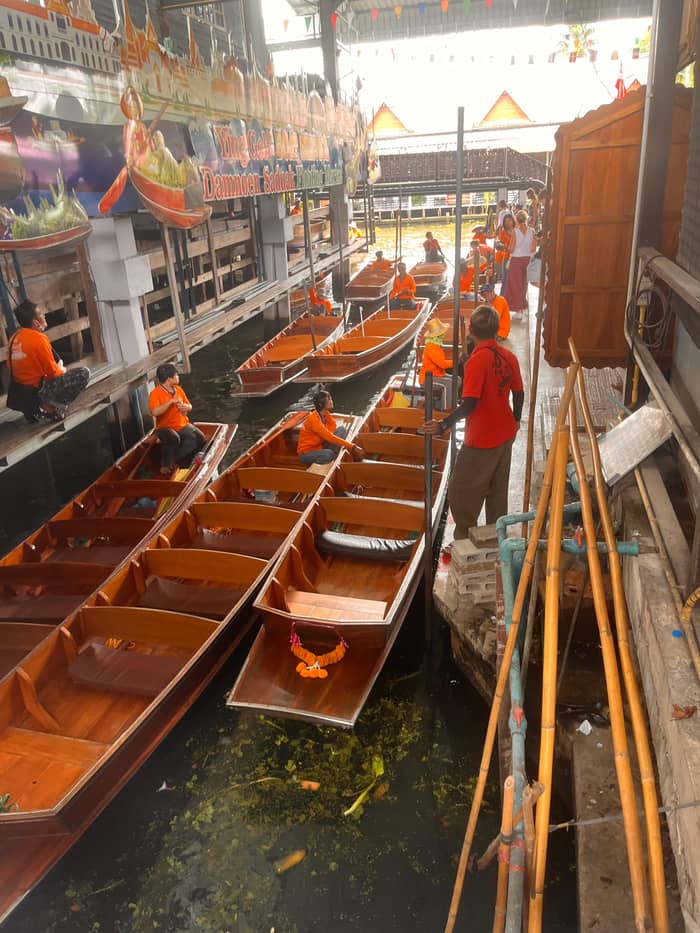
Strong sun
March to May
Plan this season
Wettest
June to October
Plan this seasonThe weather service describes the second half of May as the start of the rainy season, with temperature falling and rain increasing.6 May averages 230 mm of rain over 11 wet days and June 188 mm over 12, counting a wet day as at least 2.5 mm in the NOAA record.8,8
The peak comes in the autumn. September is the peak: 351 mm over 16 wet days in the NOAA record,8 and the weather service gives it the heaviest monthly rainfall of the year in most areas.3 October follows with 271 mm on 13 days,8 and cool weather begins from the middle of the month in Upper Thailand.7
A wet day does not cancel the day, but it changes it. Paths are slick, boat seats are damp and the light is flat for photographs. If your dates fall in the rainy months, pick a morning departure and bring a rain jacket that dries quickly. July and August bring 227 mm and 274 mm of rain in the record.8,8
The morning window
5:50 AM
The standard listing offers hotel pickup at 5:50 AM.
Early morning
A coach of 1.5 hours leads to the first market.
Mid-morning
A stop of 1.5 hours with a panoramic train ride.
Late morning
A stop of 1.5 hours, arriving by paddle boat.
1:30 PM
The earliest pickup returns around 1:30 PM.
Visiting the Damnoen Saduak floating market on a weekday has no official answer in the sources we could cite. We found no statement from the tourism authority that separates weekdays from weekends at this market, so we do not invent a pattern.
What the authority does say concerns its neighbour. Amphawa tends to be quite busy at weekends because of riverfront markets that attract day trippers from Bangkok, so it suggests visiting mid-week.9 Do not copy the weekend advice for Amphawa across without checking: TAT lists that market as open on Fridays, Saturdays and Sundays, with 15.00 to 20.00 given as the recommended time.10
If you have a choice, a weekday morning may well be calmer, though we found no measured data for this market; the tourism authority's remark about weekend day trippers at Amphawa is the only hint.9 Book the earliest departure whichever day you pick.
Video

Saint Miichael on YouTube · Until you tap play, no video is loaded.
making the months from November to February the best time to travel for tourists, as they can enjoy a respite from the usual tropical heat
Pack by season
On the standard day, the clock looks like this. Hotel pickup at 5:50 AM leads to a return around 1:30 PM, while pickups at 8:00 AM or 9:00 AM return around 3:30 to 4:00 PM. The earliest pickup puts you at the floating market in the morning window the tourism authority describes.2
The train and boat experience gives another set of times: tours at 6:30 AM, 8:30 AM, 9:00 AM and 10:00 AM, returning from around 1:45 PM to around 6:30 PM. A train-and-market listing steers guests towards its 6:00 AM and 6:30 AM starts, for thinner crowds and longer at both markets.
If you are travelling to or from the airport on the same day, choose the earliest slot and leave a margin. One coach and train listing does not recommend booking when you fly out on the same day, and another refuses refunds to guests who miss the tour. A morning market and a flight do not mix well.
If you can choose your month, pick from November to February. The cool, dry weather makes the canal pleasant, and the authority's own advice for the cool season applies.1 December is the driest month in the record, with 13 mm of rain.8
If your dates are fixed in the hot months, pick the earliest departure and wear a hat. Should your trip land in the rainy season, accept that some mornings will be wet and plan loosely; a booking that is free to cancel up to 24 hours ahead lets you swap dates when the forecast turns poor.
Whichever month you pick, the rule is the same: go in the morning. Early-morning activity is the authority's own description of the market,2 listings recommend departures before the crowds, and the earliest slot gets you back by early afternoon.
FAQ
TAT describes it as active in the early morning; tours visit it for around 1.5 hours.2
TAT says Amphawa is busy at weekends, but offers no weekday pattern for Damnoen Saduak.9
The standard day offers hotel pickup at 5:50 AM, 8:00 AM or 9:00 AM.
The NOAA record for September counts 16 wet days, meaning at least 2.5 mm of rain each.8
Sources
Heading to Damnoen Saduak? Ask a real person here.